Occupational therapist jobs in London and private work
Therapyway Editorial Team · Published 27 July 2026 · Updated 27 July 2026 · 10 min read
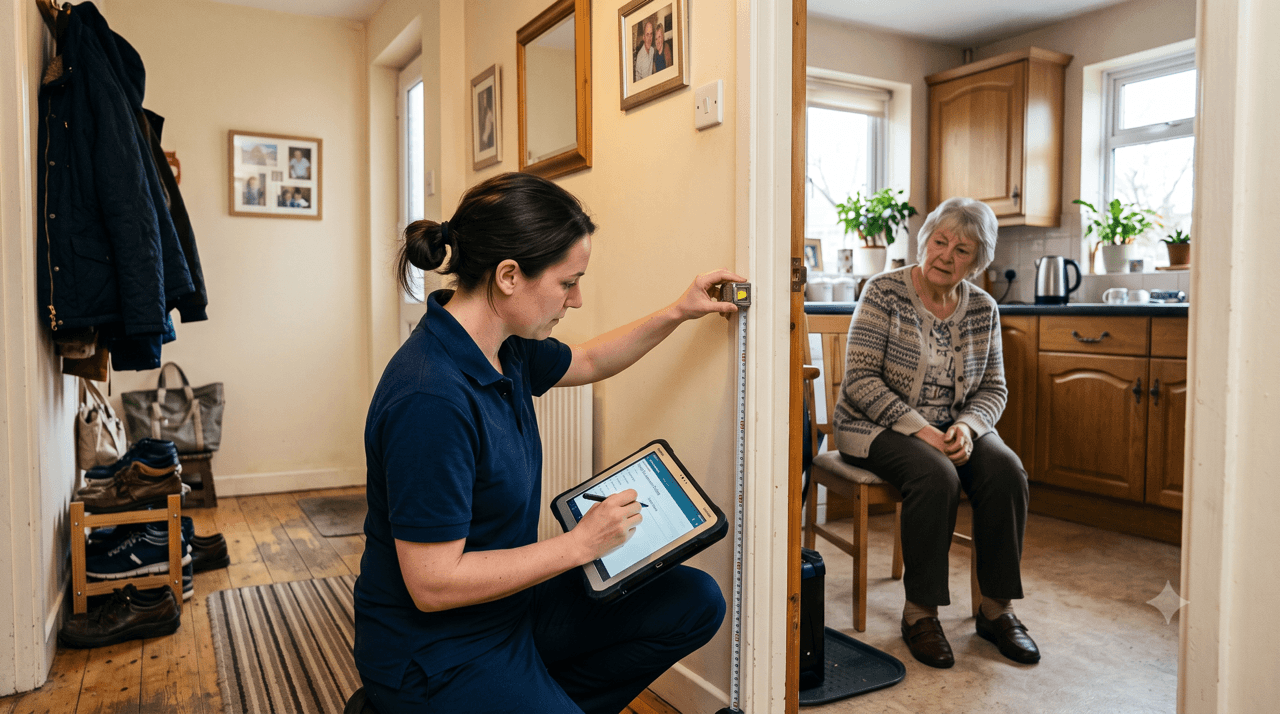
If you are looking for occupational therapist jobs in London, three places carry most of the real vacancies: NHS Jobs, the individual London borough council sites, and RCOT Jobs. The council sites are the ones worth adding to your list, because a large part of the OT workforce sits in local authority adult social care rather than the NHS.
This is not a vacancy list. Therapyway is a marketplace rather than an employer, so we do not advertise posts. What follows is what the job boards leave out: how OT roles in London are actually structured and paid in 2026/27, why the independent side of the profession is so much smaller than people assume, and what private OT work consists of once you look past the phrase "private practice". If you only came for listings, the three sources above will serve you better than anything below.
Where London occupational therapy vacancies are actually posted
OT is split across health and social care in a way that speech therapy and physiotherapy are not, and that split decides where the adverts live.
NHS Jobs covers acute trusts, community trusts and mental health trusts across the 32 boroughs. Standard Agenda for Change terms, standard pension.
Borough council sites carry the adult social care posts, and those are advertised through each council’s own recruitment portal rather than NHS Jobs. With 32 boroughs plus the City of London, checking them is tedious work, and it is the part of the search most people give up on first.
RCOT Jobs is the profession’s own board. Lower volume, better signal, and it carries independent and third sector roles that never reach the big aggregators.
Schools and SEN provision recruit both directly and through education agencies, with some of the London paediatric work appearing on TES.
Independent providers, case management companies and neuro rehab units tend to recruit through their own sites and through people they have worked with before.
One thing to watch on the general aggregators. A search for occupational therapist roles in London returns results in the hundreds, but that count folds in OT assistants, technicians, support workers and roles that merely mention occupational therapy in the description. Filter to registered practitioner posts before you judge the market.
What occupational therapist jobs in London pay in 2026/27
For NHS posts under Agenda for Change, from 1 April 2026:
Band | Typical OT role | Annual salary (2026/27) |
|---|---|---|
5 | Newly qualified or rotational | £32,073 to £39,043 |
6 | Specialist OT | £39,959 to £48,117 |
7 | Highly specialist or team lead | £49,387 to £56,515 |
London posts add a High Cost Area Supplement. Inner London is 20% of basic salary in 2026/27, with a minimum of £5,794 and a maximum of £8,746. Outer London and Fringe pay less. Two OT posts at the same band in different boroughs can differ by several thousand pounds a year on the supplement alone, so check the zone before comparing offers.
One caveat, and it matters because so much OT work sits outside the NHS. Local authority posts are often on council pay scales rather than Agenda for Change, with a different pension scheme and different terms. A council role described as Band 6 equivalent is not automatically the same package as an NHS Band 6. Ask which framework the role sits under, and ask about the pension specifically.
The part of the profession almost nobody sees
Here is the number that reframes the whole question.
As of July 2026 the HCPC register holds 47,885 occupational therapists. Where they actually work is the more revealing part.
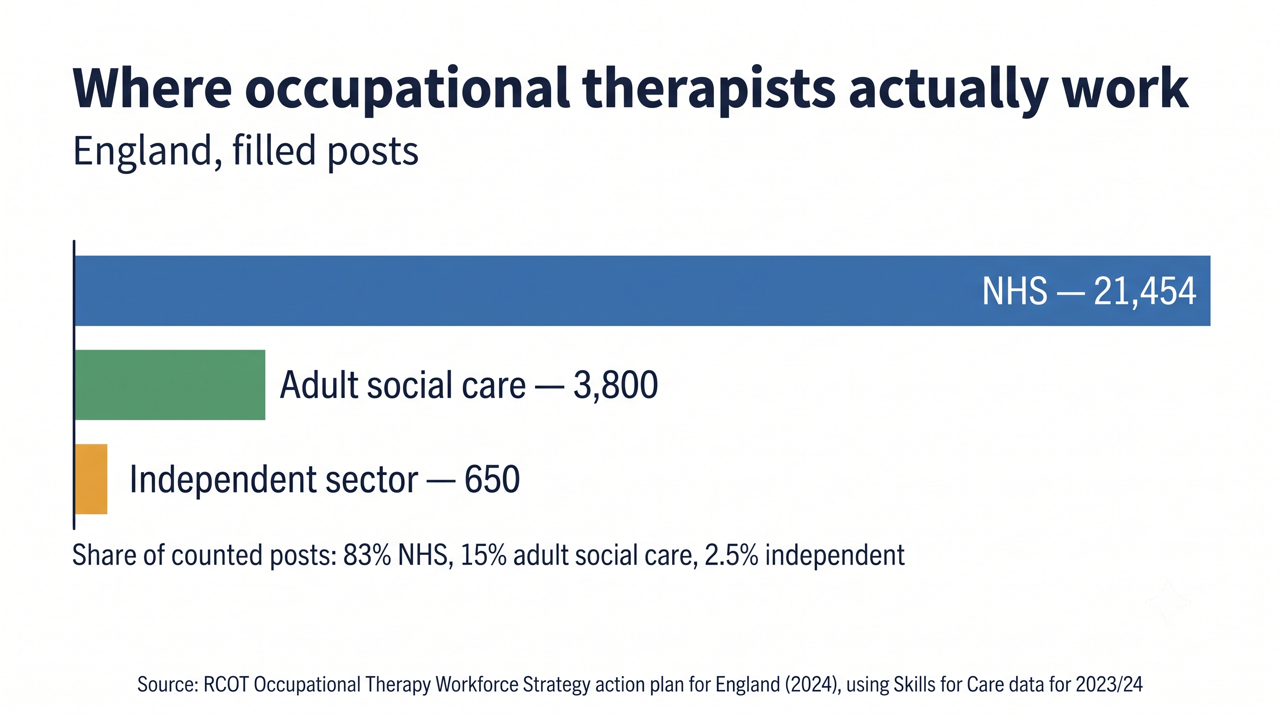
RCOT’s workforce strategy action plan for England, drawing on Skills for Care data for 2023/24, counts roughly 21,454 occupational therapists working in the NHS, about 3,800 filled OT posts in adult social care with 3,200 of those in local authorities, and just 650 working in the independent sector. Those are England filled posts from 2023/24 and the register is a UK-wide count that includes people not currently practising, so the two do not subtract neatly. The shape is what matters.
Six hundred and fifty, against more than twenty-one thousand in the NHS.
The same strategy records an average annual leaver rate of 8% for the profession, against 6.9% across other allied health professions, and in July 2024 counted 8,957 adults and 19,070 children and young people waiting to see an occupational therapist in the community. RCOT separately notes the UK has around six occupational therapists per 10,000 people, with the profession growing at roughly 2% a year.
So: documented waiting lists, a workforce leaving faster than its allied health peers, and an independent sector of 650 people.
Read those three together and the independent side of OT looks strikingly uncrowded relative to the demand sitting next to it. One plausible reason is that private OT is harder to enter than it appears, because it is not a single market at all.
RCOT reports that some services in London and the south east are running very high vacancy rates. It has not published a measured regional figure, so treat that as a signal about pressure rather than a number to plan around.
Private occupational therapy is five different jobs
This is where OT diverges sharply from speech therapy or physiotherapy. "Going private" as a physio usually means seeing clients for sessions. For an OT it can mean any of the following, and they require different skills, different insurance conversations and different marketing.
Direct private clients. Assessment and intervention paid for by the person or their family. Paediatric work including sensory integration, neurological rehabilitation, hand therapy, and support for older adults staying independent at home. This is the closest thing to a conventional private caseload.
Housing and adaptations. Assessing homes and specifying adaptations, from level access showers and door widening through to through-floor lifts. Some of this is commissioned privately, and a good deal of it sits alongside the Disabled Facilities Grant process, where an OT assessment is the gateway and council capacity is often the bottleneck. Councils commission independent OTs to clear these backlogs.
Medico-legal and expert witness work. Personal injury and clinical negligence cases, where an OT assesses functional ability, care needs, equipment and adaptations, and produces a report that will be read by solicitors and tested in court. It is unforgiving of imprecision. Requirements vary between instructing firms, but substantial post-qualification experience in your specialist area is normally expected before anyone instructs you, and writing to court standards is a distinct skill from clinical note keeping.
Case management. Coordinating rehabilitation and support for someone with complex needs, often funded through a personal injury settlement, including vocational case management. Long relationships rather than discrete episodes.
Vocational rehabilitation and occupational health. Workplace assessments, return to work planning, advising employers on adjustments and access. Commissioned by employers and insurers rather than individuals, which changes both the sales cycle and who your client actually is.
Portfolio working across two or three of these at once is common in occupational therapy, more so than in most allied health professions. It is worth planning for deliberately rather than drifting into.
What you need in place before you take private work
HCPC registration. "Occupational therapist" is a protected title, and unlike speech and language therapy it is the only one for this profession. Under Article 39(1) of the Health Professions Order 2001 it is a criminal offence to use a protected title with intent to deceive when you are not on the register, and the HCPC notes that prosecution can lead to a substantial fine and a criminal record. The offence is about holding yourself out as registered when you are not. A lapsed renewal is a registration problem to sort out with the HCPC rather than the same thing, though you should stop practising and stop using the title until it is resolved. The offence also covers implication, so check how your profile and any marketing describe you.
Insurance, and read this one properly. The HCPC requires appropriate indemnity cover as a condition of registration. RCOT membership includes professional indemnity cover of up to £10 million on a loss occurring basis, and it covers you as an individual whether you are employed, self-employed, or both. It does not cover a company or partnership you set up. If you incorporate, the entity needs its own policy in its own name. That is an easy thing to miss when the company was formed for tax reasons and the clinical work has not changed.
A DBS check. Enhanced, with the relevant barred list for the groups you work with. Scotland uses PVG and Northern Ireland uses AccessNI. You can apply for a basic check yourself, but enhanced checks usually need an organisation to countersign.
HMRC registration. Self assessment, VAT threshold monitoring, National Insurance. Before the first invoice.
Supervision and CPD. CPD is a condition of HCPC registration, and independent practice removes the informal supervision that comes free with a team. Arrange it deliberately. If you are working across NHS and independent contexts, keep the arrangements separate.
Where Therapyway fits
Therapyway is a marketplace connecting people looking for therapy with independent, HCPC-registered therapists across the UK. We are not an employer, we hold no vacancies, and registering is not a job application.
What it handles is the direct private client strand, which is the one that depends on being found by people already searching. You publish a profile with your qualifications, specialisms, availability, location and rates. Clients send appointment requests. Scheduling, records, messaging and payments run in the same place. The other four strands above, particularly medico-legal and case management, come through solicitors, insurers and professional networks, and no marketplace substitutes for those.
The commercial terms in full: joining is free with no card required, and we take 10% of paid bookings only. On an £80 session you keep £72. HCPC verification is the only gate on registration.
What we cannot tell you is how much work will come. We do not guarantee referrals, bookings or income, and any platform that promises otherwise deserves scepticism. Read the current registration terms before you sign up, and treat it as one channel rather than a replacement for a referral network you already have.
Frequently asked questions
Does Therapyway have occupational therapist vacancies in London?
No. Therapyway is a marketplace rather than an employer and does not advertise posts. For salaried London vacancies, use NHS Jobs, the individual borough council recruitment sites, and RCOT Jobs. Therapyway is relevant if you want private clients alongside or instead of a post.
Can I do private work while employed by the NHS or a council?
Many OTs do. Check your contract for secondary employment and conflict of interest clauses first, tell your employer if the contract requires it, and never take private referrals from your own statutory caseload.
How much does private occupational therapy cost in the UK?
Private sessions commonly run from £60 to £120 for around 50 minutes, with London towards the upper end and specialist work sometimes above it. You set your own rates on Therapyway. Treat that as the price the client pays rather than your take-home: platform commission, unbilled report writing, travel, insurance and CPD all come out of it before any comparison with an hourly NHS rate.
Do I need to be on Agenda for Change to work in a London borough?
Not necessarily. Many local authority OT posts sit on council pay scales with a different pension. Confirm which framework applies before accepting.
Is "occupational therapist" a protected title?
Yes, and it is the only protected title for the profession. Using it with intent to deceive when not HCPC-registered is a criminal offence.
Does my RCOT insurance cover my limited company?
No. RCOT cover applies to you as an individual member. A company or partnership needs a separate policy in its own name.
I qualified outside the UK. What do I need?
HCPC registration through the international route before you practise or use the title here. That has to be complete before you register with Therapyway.
Ready to take private clients?
If you are HCPC-registered and want to build a private caseload on your own terms, you can see how Therapyway works for therapists and register in a few minutes. Free to join, 10% on paid bookings, no vacancy application involved.