Speech therapist jobs in London and the private route
Therapyway Editorial Team · Published 27 July 2026 · Updated 27 July 2026 · 10 min read

If you are searching for speech therapist jobs in London, start with NHS Jobs and RCSLT Jobs. Those two carry most of the genuine London vacancies, from Band 5 posts through to highly specialist roles, and they are updated far more reliably than the general job aggregators.
This article is not a vacancy list. Therapyway is a marketplace, not an employer, and we do not advertise posts. What follows is the thing the job boards will not tell you: what those London roles actually pay in 2026/27, why so many of them stay open for months, and how private caseload work compares if you want more control over your week. If you only wanted the listings, the links above will serve you better than anything below.
Where London speech and language therapy vacancies are actually posted
Each source is good for something different, and knowing which is which saves a lot of scrolling.
NHS Jobs carries community, acute and mental health trusts across all 32 boroughs. If you want an Agenda for Change post with a pension, this is the primary source and most of the aggregators are just mirroring it.
RCSLT Jobs is the profession’s own board. Smaller volume, but the listings are written by people who understand the role, and it carries independent practice and school-based work that does not appear on NHS Jobs.
ASLTIP is a directory of independent practitioners rather than a job board. Practices do recruit associates through it, but you are joining a professional listing rather than applying to a post.
Agencies and locum desks dominate the general aggregators. Useful for short-notice cover and for trying a setting before you commit to it, less useful if you want continuity with a caseload.
Independent practices and school groups often recruit directly through their own sites or through people they already know, so a share of London work is never advertised at all.
One practical note on the aggregators. Search "speech therapist London" on Jooble and you will see a figure in the thousands. Search the same thing on Totaljobs and the count for speech and language therapist roles specifically drops to around twenty. The high numbers include duplicates, assistant and support posts, and roles that matched on a keyword. Judge the market by the specific boards, not the headline count.
What speech therapist jobs in London pay in 2026/27
Under Agenda for Change, from 1 April 2026 the relevant bands are:
Band | Typical SLT role | Annual salary (2026/27) |
|---|---|---|
6 | Specialist SLT | £39,959 to £48,117 |
7 | Highly specialist or team lead | £49,387 to £56,515 |
On top of basic pay, London posts attract a High Cost Area Supplement. For Inner London this is 20% of basic salary in 2026/27, subject to a minimum of £5,794 and a maximum of £8,746. Outer London and Fringe rates are lower. Check which zone a trust sits in before you compare two offers, because the difference between Inner and Fringe is worth several thousand pounds a year on the same band.
Locum and agency rates sit differently again, and vary too much by setting and notice period for a single figure to be meaningful. Ask for the day rate and the umbrella arrangement in the same conversation.
Why so many London posts stay open
This is the part that rarely makes it into a job advert, and it explains a lot about what the London market feels like from the inside.
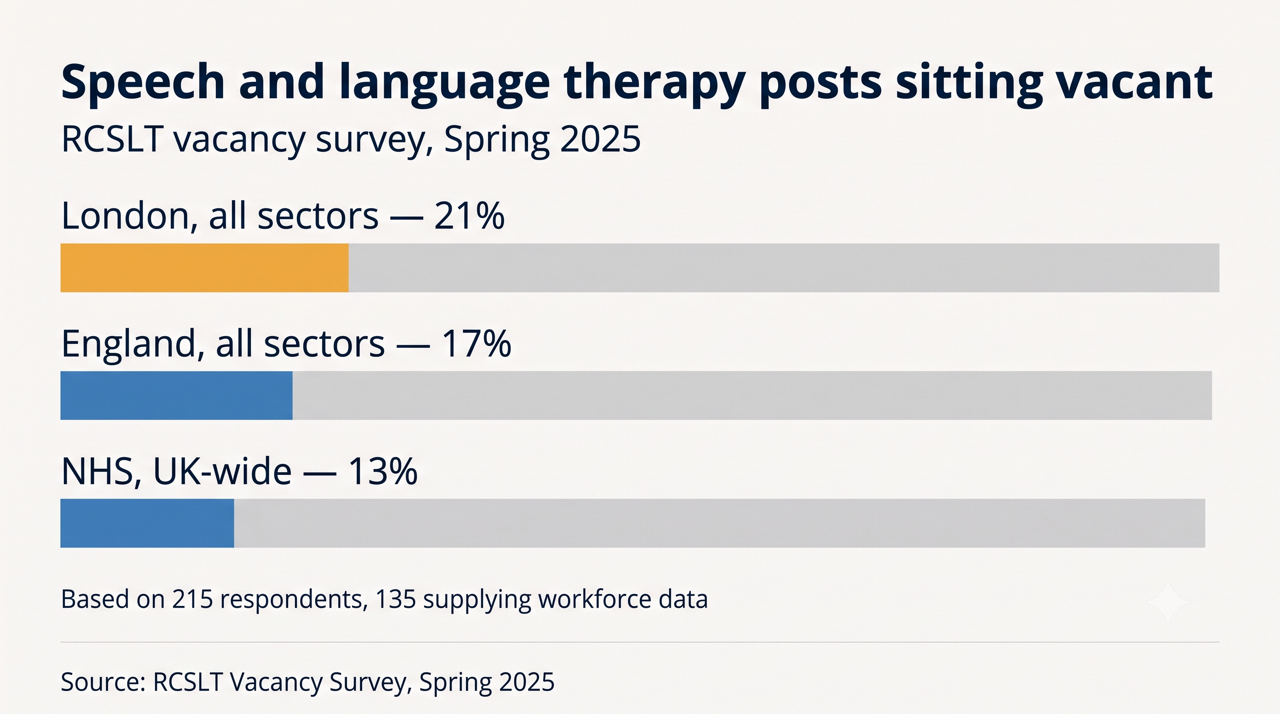
The RCSLT’s Spring 2025 vacancy survey found that 21% of London’s speech and language therapy posts were vacant, against 17% across England as a whole and 13% in the NHS UK-wide. Learning disability services were hit hardest, with 24% of NHS SLT posts vacant. The survey drew on 215 respondents, 135 of whom supplied workforce data, so treat it as a strong indicator rather than a census.
Demand has not softened to match. A Department of Health and Social Care answer to a written parliamentary question in June 2026 put 66,695 children and young people on speech and language therapy waiting lists in England as of April 2026.
The pool those services are recruiting from is small. As of July 2026 the HCPC register holds 20,620 speech and language therapists across the whole UK, the smallest of the three professions on this site by some distance, against 47,885 occupational therapists and 77,341 physiotherapists.
Two things follow from that, and they pull in opposite directions.
If you want an NHS post in London, you are in a strong position. Services are competing for you, and there is room to negotiate on band, on part-time patterns and on the shape of the caseload.
If you take one, you are also likely to be carrying a caseload sized for a team that is not fully staffed. The same shortage that gives you leverage at interview is the thing that shapes your workload afterwards, and it is worth asking at interview how long the vacancies in that specific team have been open and what has been done about the caseload in the meantime.
Both of those things are true at once, which is why the private route is worth understanding even if you have no intention of leaving the NHS.
The private route: what it looks like in practice
Private work is not an all-or-nothing decision, and framing it that way puts people off unnecessarily. In practice it tends to take one of three shapes.
Alongside a substantive post. A part-time NHS contract keeps the pension and the peer supervision while a small private caseload runs in evenings or on a non-working day. This is the lowest-risk way in, because you are not betting your income on the caseload filling. Check your NHS contract for conflict of interest and secondary employment clauses first, and be clear with yourself that you cannot take private referrals from your own NHS caseload.
Associate work within an existing practice. You are self-employed, but another practice supplies the clients and often the assessment resources. You still handle your own tax, insurance and CPD. Less admin than going solo, and less margin.
Fully independent. Your own practice, which means your own referral pipeline and your own overheads.
The honest trade-off is this. The hourly figure looks much better than the NHS equivalent, but you are not paid for the hours you spend on report writing, unbilled admin, marketing, chasing invoices or the gaps when a family cancels. Once those are priced in, a busy independent caseload tends to land closer to a senior NHS salary than the headline rate suggests. What genuinely changes is control: over your diary, your specialism, your assessment approach, and how many clients you take.
What you need in place before you take private clients
None of this is optional, and getting it wrong is a regulatory problem rather than an administrative one.
HCPC registration. "Speech and language therapist" and "speech therapist" are both protected titles. Under Article 39(1) of the Health Professions Order 2001, using one with intent to deceive when you are not on the register is a criminal offence, and the HCPC notes that prosecution can lead to a substantial fine and a criminal record. The offence turns on holding yourself out as registered when you are not. Letting a renewal lapse is a registration problem to fix with the HCPC, not the same thing, though you should stop practising and stop using the title until it is resolved. Note too that the offence covers implication as well as direct use, so review how your profile and marketing describe your services.
Professional indemnity insurance. The HCPC requires appropriate cover as a condition of registration. RCSLT membership includes public liability cover, but check the limits and confirm whether your specific work, particularly anything involving dysphagia or work in clients’ homes, needs additional cover.
A DBS check. In England and Wales you will need an enhanced check with the relevant barred list. Scotland uses PVG and Northern Ireland uses AccessNI. Basic checks you can apply for yourself, but enhanced checks usually need an organisation to countersign, which is one reason independent practitioners join ASLTIP.
HMRC registration. Register for self assessment, track the VAT threshold, and understand your National Insurance position. Do this before your first invoice, not after.
Supervision. If you work across both NHS and independent contexts, the RCSLT is explicit that you need separate supervision arrangements for each.
Experience. ASLTIP full membership requires HCPC registration, current RCSLT membership and a minimum of two years post-qualification experience. Affiliate membership exists for newly qualified SLTs working under supervision from a full member. This is a reasonable benchmark even if you never join: private caseloads come without the safety net of a team around you.
Where Therapyway fits
Therapyway is a marketplace that connects people looking for therapy with independent, HCPC-registered therapists across the UK. We are not an employer and we do not hold vacancies, so joining is not an application for a job.
What it does is handle the part most independent SLTs find hardest, which is being found by people who are already searching. You publish a profile with your qualifications, specialisms, availability, location and rates. Clients find you and send appointment requests. Scheduling, records, messaging and payments run through the same place.
The commercial terms, in full: joining is free with no card required, and we take 10% of paid bookings only. On an £80 session you keep £72. HCPC verification is the only gate on registration.
What we cannot tell you is how much work you will get. We do not guarantee referrals, bookings or income, and any platform that promises otherwise is worth treating with suspicion. Whether clients approach you depends on your specialism, your location, your rates and how many people in your area are searching for what you do. Read the current registration terms before you sign up, and treat it as one channel among several rather than a replacement for a referral network you already have.
Frequently asked questions
Does Therapyway have speech therapist vacancies in London?
No. Therapyway is a marketplace rather than an employer, and we do not advertise posts. For salaried London vacancies, use NHS Jobs and RCSLT Jobs. Therapyway is relevant if you want private or freelance clients alongside or instead of a post.
Can I take private clients while working for the NHS?
Many SLTs do, but check your contract for secondary employment and conflict of interest clauses first, tell your employer if required, and never accept private referrals from your own NHS caseload.
How much do private speech and language therapy sessions cost in London?
Private sessions in the UK commonly run from £60 to £120 for around 50 minutes, with London rates towards the upper part of that range and specialist work sometimes above it. You set your own rates on Therapyway. Read that as the price the client pays, not your take-home: platform commission, unbilled report writing and admin, insurance and CPD all come out of it before you compare it with an hourly NHS equivalent.
Do I need two years of experience to work privately?
Not as a legal requirement. HCPC registration is the legal threshold. Two years post-qualification is the ASLTIP full membership benchmark, and it is a sensible marker of readiness given how much independent practice relies on your own clinical judgement.
Is "speech therapist" a protected title?
Yes. Both "speech therapist" and "speech and language therapist" are protected under HCPC regulation, and misuse with intent to deceive is a criminal offence.
What if I am an internationally qualified SLT?
You will need HCPC registration through the international application route before you can practise or use the title in the UK. That process sits with the HCPC and needs to be complete before you register with Therapyway.
Ready to take private clients?
If you are HCPC-registered and want to build a private caseload on your own terms, you can see how Therapyway works for therapists and register in a few minutes. Free to join, 10% on paid bookings, no vacancy application involved.
Sources
HCPC, misuse of title and Article 39(1) of the Health Professions Order 2001
HCPC register summary, registrant numbers by profession, valid as of July 2026
RCSLT Vacancy Survey, Spring 2025 (215 respondents, 135 supplying workforce data)
NHS Employers, Agenda for Change pay scales from 1 April 2026
Department of Health and Social Care, written parliamentary answer, June 2026
ASLTIP, Association of Speech and Language Therapists in Independent Practice